Novel Editing Services: What Authors Should Check Before Paying an Editor

Hiring the right editor for your novel is critical. Editing costs can exceed $3,000 for a 100,000-word manuscript, and a poor choice can harm both your book and budget. To avoid mistakes, here’s what you should evaluate before paying:
- Credentials and Experience: Verify the editor's background in publishing, check testimonials, and ask for references. Look for memberships in professional organizations like the Editorial Freelancers Association.
- Genre Expertise: Ensure the editor understands your book's genre and sub-genre to meet reader expectations.
- Editing Services: Know the types of editing (developmental, copyediting, proofreading) and choose what aligns with your manuscript's needs.
- Pricing Transparency: Request an itemized quote, including scope, deadlines, and revision rounds.
- Sample Edit: Ask for a trial edit to assess their style, quality, and communication.
- Professionalism: Evaluate their response time, clarity, and project management practices.
Taking these steps ensures your manuscript and investment are in capable hands.
Check the Editor's Credentials and Experience
Look for Relevant Industry Experience
Not everyone who claims to be an editor is actually equipped to handle your novel. Since the publishing industry lacks a governing body or mandatory certifications, anyone can offer editing services, regardless of qualifications. One of the best indicators of a credible editor is a background in traditional publishing. Former literary agents or in-house editors from established publishing houses are often well-versed in what makes a manuscript marketable. They’ve worked with acquisitions editors and understand how to shape a book for commercial success. On the other hand, experience in fields like journalism or teaching, while valuable in their own right, doesn’t necessarily prepare someone for the nuances of book editing.
"A background in teaching or journalism does not meet the specialized demands of book editing." - Tiffany Yates Martin, Author and Editor
Here’s a tip: check the acknowledgments section in books you admire. Authors often credit their freelance editors, giving you a direct lead to someone with proven expertise. Membership in professional groups like the Editorial Freelancers Association (EFA) or the Book Editors’ Alliance also shows a commitment to professional standards. After verifying their background, take the next step by reviewing client testimonials to gauge their effectiveness.
Ask for Testimonials and References
While testimonials on an editor’s website can be helpful, they’re often curated to highlight only positive feedback. What’s more reliable is a direct reference from a previous client - preferably a published author - who can vouch for the editor’s communication, dependability, and the quality of their work. Don’t hesitate to ask for contact details for at least two past clients. A seasoned editor should have no problem providing references. If they’re reluctant, it could be a red flag.
As editor Don White advises:
"Be wary of anyone offering to work at an unusually low rate. While the constraints of your budget will dictate whom you can afford to hire, make sure the editor you're selecting is a reliable, experienced professional or you're wasting your money."
You can also do a quick online search to confirm the editor’s qualifications, published work, and reputation within the writing community. Resources like Writer Beware and the Absolute Write Water Cooler are invaluable for identifying editors with a history of unprofessional behavior or poor results.
sbb-itb-df9dc23
Confirm Genre-Specific Knowledge
Check for Genre Compatibility
Once you've verified an editor's credentials, the next step is to ensure they truly understand your genre. While a generalist editor may excel at catching grammar mistakes or structural flaws, they might overlook the finer details that give a genre its distinctive flavor - like pacing norms, recurring tropes, or the intricacies of world-building.
Ask the editor about their preferred genres to gauge their expertise. Lesley-Anne Longo from The Editing Company highlights the importance of this:
"If you love reading science fiction novels... you'll know the common tropes and frameworks, be familiar with the art of worldbuilding, and you'll have knowledge of the sub-genres... You'll already come to the table with intimate knowledge that other editors won't have."
This kind of genre-specific knowledge is invaluable. For instance, an editor well-versed in science fiction would likely catch an inconsistency like referencing "champagne" in a setting that lacks Earth or French cultural ties. Make sure the editor not only understands your genre but also your sub-genre. Whether it's steampunk, space opera, medical thrillers, or culinary mysteries, their experience should align with your manuscript's needs.
Having an editor with this level of insight ensures they can help you refine your story in a way that resonates with genre fans. Once you've confirmed their grasp of genre conventions, the next step is to ensure your manuscript delivers on reader expectations.
Know Your Reader Expectations
Every genre comes with its own set of unspoken rules - guidelines that readers rely on to shape their experience. These conventions act as a kind of promise between the writer and the reader. As writing coach Julia Amante explains:
"These unspoken rules - regarding tone, pacing, structure, character types, tropes, and themes - serve as a contract between the writer and the reader. When you break that contract, readers feel confused or disappointed."
A skilled, genre-savvy editor can help you uphold this "contract." For example, in romance, a satisfying resolution - whether a "Happily Ever After" (HEA) or "Happily For Now" (HFN) - is absolutely essential. Lesley-Anne Longo emphasizes this point:
"Ending a book with the protagonist's love life in tatters and dangling on the precipice of a breakdown might fly in literary fiction, but I can tell you right now that romance fans will not appreciate it."
Failing to meet these expectations can have a significant impact. Studies reveal that over 70% of readers stop reading early when a book doesn't align with genre norms.
ALL ABOUT BOOK EDITORS: how to FIND, HIRE, & WORK with a professional book editor + WHEN to do this
Understand What You're Paying For
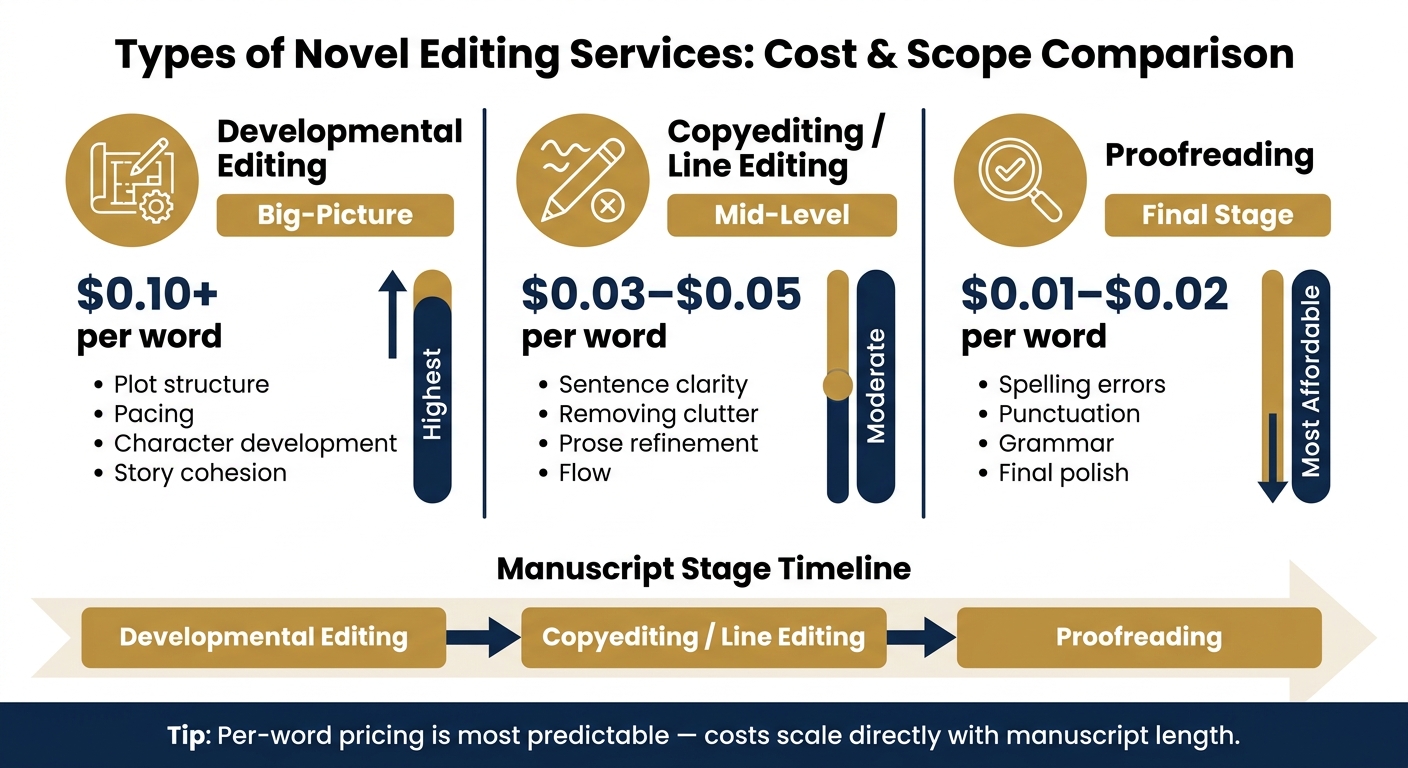
Types of Novel Editing Services: Cost & Scope Comparison
Know the Different Types of Editing
Editing services come in different forms, each addressing a specific layer of your manuscript. Understanding these can help you choose the right service for your needs.
Developmental editing tackles the big-picture elements of your book - plot structure, pacing, character development, and overall story cohesion. This type of editing is thorough and comes with a higher price tag, starting at $0.10 or more per word. Copyediting (also known as line editing) focuses on refining your sentences by removing clutter, improving clarity, and tightening your prose. It’s more affordable, typically costing $0.03–$0.05 per word. Lastly, proofreading is the final stage, where spelling, punctuation, and grammar errors are corrected. This is the most economical option, averaging $0.01–$0.02 per word.
As editor Ann Howard Creel explains:
"All authors benefit from making changes and revising well before the manuscript is seen by a publisher or reader, and it starts on the first page."
By pinpointing your manuscript's current stage, you can avoid paying for services you don’t need and focus on what will truly benefit your book. Once you’ve identified the right type of editing, be sure to gather detailed pricing information to avoid unexpected costs.
Get a Clear, Itemized Quote
Before committing to an editor, request a written, itemized quote. Transparency in pricing is essential. As Staci Frenes emphasizes:
"Transparency and clarity about fees and other logistics is crucial as well. An editor should disclose what you'll be paying for their services, what kind of editing you'll be getting, and approximately how long the process will take from start to finish."
A good quote should outline the scope of deliverables - such as an editorial letter, in-line comments, or a style sheet - along with the number of revision rounds included, delivery deadlines, and the pricing model (whether it’s per word, per hour, or per project). For authors, per-word pricing tends to be the most predictable since it directly ties costs to the manuscript's length.
Don’t hesitate to ask questions like, "How many edit rounds are included?" and "What are the costs for extra rounds?". Frenes offers a word of caution:
"You don't want an editor to hang on to your manuscript for months on end, and then keep asking for more money to finish it! Get the terms up front."
Also, confirm any additional fees for extras like book blurbs or promotional materials. Having all terms documented in writing will save you from potential surprises later on.
Request a Sample Edit Before Committing
Why a Trial Edit Is Worth It
Before handing over your entire manuscript, consider requesting a sample edit. This small step - just a few pages - can give you a clearer sense of whether an editor is the right match for your project.
A sample edit can reveal issues that resumes or glowing testimonials might not. As Jeff Karon, PhD English at Book-Editing.com, puts it:
"Providing an editor/proofreader with a sample allows the editor to see what you have missed."
A good editor should identify technical problems like point-of-view inconsistencies or punctuation mistakes. They’ll also clarify the level of editing your manuscript needs, which can directly affect both the timeline and cost of the project.
If you're hesitant to share the entire manuscript, you can submit pages from different chapters. This gives the editor a better sense of your writing style across the book, ensuring a more accurate evaluation.
Once you receive the sample edit, take time to review the feedback carefully to confirm it aligns with your expectations.
How to Evaluate Sample Feedback
When you get the edited sample back, the first step is to check if the feedback is detailed and addresses your specific concerns. Be upfront with the editor about what you’re looking for, and then assess whether their suggestions tackle those points or lean too heavily on their personal style preferences.
Look out for warning signs in the feedback. JoEllen Nordstrom, Word Wizard at First Editing, cautions:
"Beware any editor who promises publication without having read your manuscript."
Editors making broad guarantees - especially without fully reviewing your work - or claiming expertise in every facet of publishing (editing, formatting, marketing, etc.) should raise a red flag. A professional editor is typically an expert in a specific area, not an all-in-one solution.
Lastly, confirm that the editor uses tools like Track Changes or other standard software to document their work. Make sure they clearly outline what you’ll receive after the sample edit, whether that’s an editorial letter, embedded comments, or a scene-by-scene breakdown. If they’re vague about deliverables, it might be a sign to explore other options.
Gauge Professionalism and Communication
Check How Quickly They Respond
An editor’s first response can tell you a lot about how they’ll handle your manuscript. Are their replies prompt, clear, and to the point? Or do they leave you with more confusion than answers? These initial interactions set the tone for your working relationship.
Staci Frenes highlights the importance of clear and timely communication. Look for responses that are specific and avoid unnecessary delays or ambiguity.
It’s also a good idea to assess their professionalism by reviewing their emails and website. If their writing is full of mistakes or feels unprofessional, consider it a warning sign. While a quick reply is important, it’s just one piece of the puzzle - strong project management is equally essential to keep your manuscript on track.
Review Their Project Management Practices
Clear communication and detailed quotes are great starting points, but effective project management is what ensures a smooth editing process. Make sure you have written agreements that outline timelines, the number of revision rounds, and deliverables. Sterling M.Z., a freelance editor, explains that developmental editing often takes time:
"You could be working with a developmental editor for three months, doing anywhere between three to four revision rounds."
Having written terms protects you from unexpected delays or costs. A dependable editor will also provide structured deliverables. For instance, a skilled copy editor should create a style sheet to track details like character names, facts, and unique stylistic decisions for your book. These tools help ensure consistency and accuracy throughout the editing process.
Conclusion: Steps to Take Before You Pay
The process of hiring an editor relies on careful evaluation. Start by verifying their credentials and ensuring they have experience in your book’s genre. Ask for a sample edit to gauge their style and quality, and make sure all terms are outlined in writing. These steps are essential to finding the right editor for your work.
JoEllen Nordstrom emphasizes the importance of this decision, stating, "Editing is the most important investment you will make in your book and writing", while cautioning against choosing an editor based solely on a low price if they lack the required skills.
Before committing to an editor, take the time to thoroughly self-edit your manuscript. Nathan Bransford, author and former literary agent, explains, "the farther you can get self-editing on your own, the more you'll get out of the editing process." A well-polished draft allows the editor to focus on broader, more impactful improvements, ensuring you get the most value out of their expertise.
FAQs
How do I know what type of edit my novel needs right now?
To determine what kind of editing your novel requires, start by assessing its current condition. Pay close attention to story structure, character development, pacing, and clarity of prose. If the manuscript has significant structural flaws, you might need a developmental edit to address big-picture issues. On the other hand, if the story is solid and you’re looking to refine the writing, copy or line editing could be the better choice. Evaluating these elements will guide you toward the right editing approach for your novel.
What should be in an editor’s contract and itemized quote?
An editor’s contract and itemized quote should cover several key elements:
- Scope of work: Clearly outline the services being provided and specify availability for revisions.
- Deliverables: Define how and when the completed work will be delivered.
- Deadlines: Include both completion dates and any responsibilities the client must fulfill to meet those deadlines.
- Payment terms: Detail the payment amount, schedule, and preferred method.
Additional clauses, such as rights to the work or terms for satisfaction, might also be included for clarity. To ensure accuracy and professionalism, consider using a reliable template or consulting a legal expert.
What are the biggest red flags when hiring an editor?
One major warning sign is when editors start rewriting your book instead of refining it. This can dilute your unique voice and compromise your authorship. A skilled editor’s job is to improve aspects like clarity, grammar, and structure - without tampering with the essence of your work.
Be wary of editors who overstep their role or ignore your creative vision. Their goal should be to support your ideas, not replace them.