AI Feedback vs. Human Feedback in Writing

AI feedback is fast and consistent, while human feedback offers deeper insights and emotional support. Both have strengths, and the best results often come from combining them. AI excels at grammar, structure, and rubric alignment, delivering instant suggestions. On the other hand, human reviewers focus on context, argument strength, and motivation, tailoring their advice to your needs.
Key Takeaways:
- AI Feedback: Instant, objective, handles large volumes, 24/7 availability, and great for early drafts.
- Human Feedback: Context-aware, supportive, prioritizes critical issues, and ideal for final drafts or complex writing.
- Best Approach: Use AI for quick fixes and human feedback for deeper revisions.
| Feature | AI Feedback | Human Feedback |
|---|---|---|
| Speed | Instant | ~20–25 minutes per essay |
| Grammar & Structure | High | Moderate |
| Context Awareness | Moderate | High |
| Encouragement | Generic | Personal and supportive |
| Rubric Alignment | Strong | Holistic |
| Complex Analysis | Limited | Strong |
AI and human feedback aren’t competitors - they complement each other. Use both strategically to refine your writing and achieve the best results.
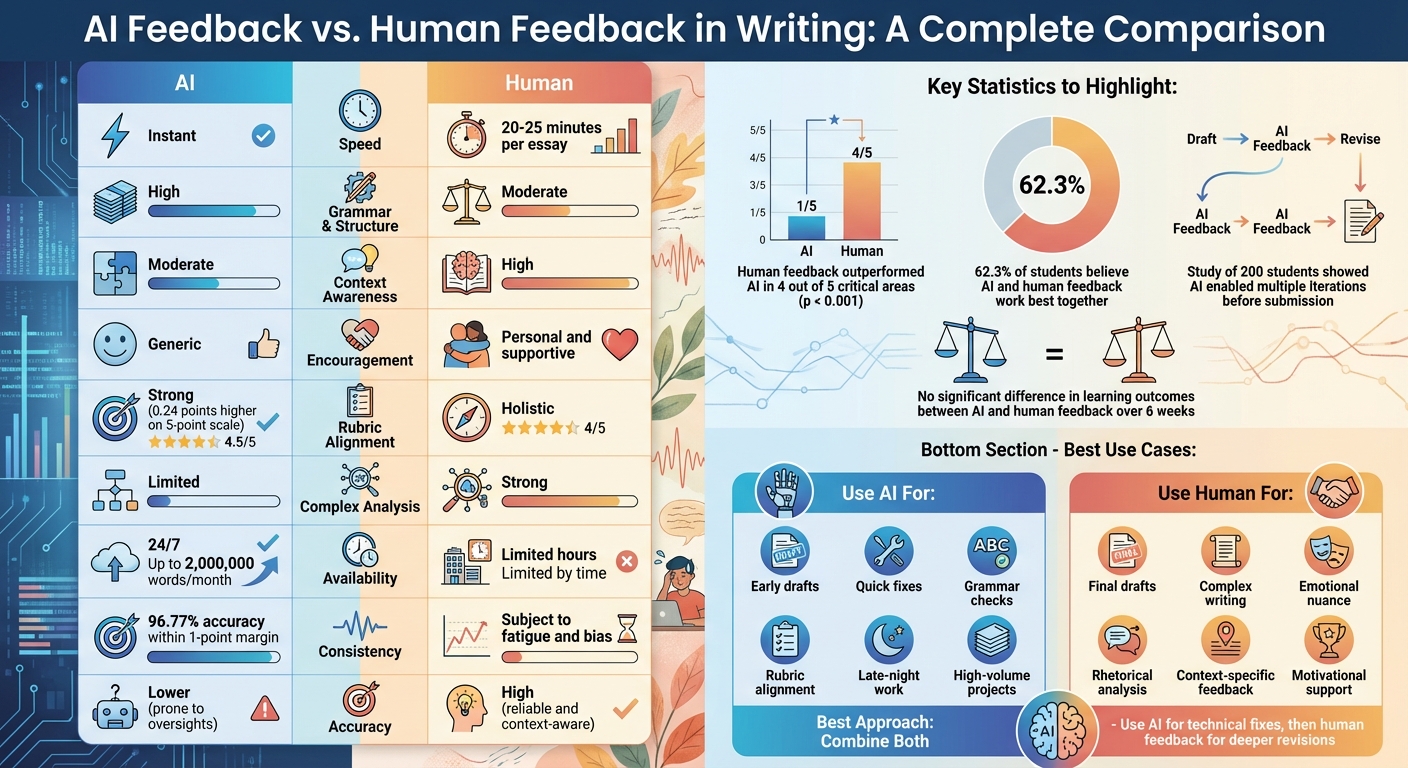
AI vs Human Feedback in Writing: Complete Comparison Chart
MYFest25: AI Feedback in a Human-Centered Writing Process: The Peer and AI Review + Reflection
What AI Feedback Does Well
AI tools have revolutionized the way writers receive feedback, delivering instant, automated guidance that sharpens precision and efficiency. While human reviewers bring unique qualities to the table, AI shines in specific areas, making it a powerful ally for modern writing tasks.
Speed and Handling Large Volumes
One of the standout benefits of AI feedback is its speed. Unlike human reviewers, who require time to provide input, AI offers immediate results. This instant feedback can transform how writers work. Instead of waiting days for a professor's comments or coordinating with a tutor, you can refine multiple drafts in real time.
This speed becomes especially valuable when you're racing against tight deadlines. Tools like Revise can process up to 2,000,000 words per month, making it possible to review everything from short emails to detailed research papers without worrying about hitting a limit. A study conducted in June 2024 by researchers Steve Graham and Mark Warschauer examined 200 secondary students in Southern California (Grades 6–12) as they wrote essays on topics like the "Delano Grape Strike." While human reviewers excelled in providing nuanced and supportive feedback, AI tools like ChatGPT enabled students to iterate on their work multiple times before submission - thanks to the immediacy of its feedback.
Consistency and Objectivity
Human reviewers, no matter how skilled, can be influenced by fatigue, personal preferences, or unconscious biases. AI, on the other hand, delivers consistent, unbiased feedback every time. In the same 2024 study, ChatGPT outperformed 16 seasoned educators in offering "criteria-based" feedback - explicitly tying suggestions to grading rubrics - scoring an average of 0.24 points higher on a 5-point scale (p = 0.03).
"Algorithmic assessment of writing reduces bias and noise and is likely more consistently accurate than the judgments of human experts." – International Journal of Educational Technology in Higher Education
This consistency is particularly useful for long projects where maintaining a uniform tone and style is critical. AI doesn’t tire after reviewing dozens of pages, nor does it offer conflicting advice on different days. An October 2023 university study in the Asia-Pacific region compared feedback for 48 English as a New Language learners over six weeks. The experimental group received AI-generated input, while the control group relied on human tutors. The findings revealed no significant difference in learning outcomes, proving AI's reliability as a scalable feedback option.
Adapting to Your Writing Style
Modern AI tools have become adept at personalizing feedback to fit your unique voice. Through advancements in prompt engineering and machine learning, platforms like Revise can analyze your linguistic patterns and tailor their suggestions to match your style. Premium features, such as the personalized writing voice available in Pro and Ultra plans, even learn from your past work to refine feedback over time.
You can also adjust the type of feedback you receive. Whether you prefer a friendly and encouraging tone or a more formal and direct approach, AI allows you to customize its suggestions. Research has shown that AI is particularly strong at evaluating reasoning, argumentation, and evidence use - areas where it occasionally surpasses human experts. Steve Graham, a writing instruction specialist at Arizona State University, remarked:
"It was better than I thought it was going to be... sometimes it was right on the money".
These personalized features make AI an effective tool for improving your writing while maintaining your distinct voice.
AI Feedback Strengths at a Glance
| Feature | AI Performance | Practical Application |
|---|---|---|
| Processing Speed | Instant feedback | Quickly review multiple drafts without delays |
| Volume Capacity | Up to 2,000,000 words/month | Handle extensive projects without worrying about limits |
| Consistency | 96.77% accuracy within a 1-point margin | Maintain a uniform style across lengthy documents |
| Availability | 24/7 access | Get feedback whenever inspiration strikes or deadlines loom |
| Criteria Adherence | Superior rubric-based feedback | Ensure alignment with academic or professional standards |
What Human Feedback Does Well
While AI shines in speed and consistency, human reviewers bring something special to the table - qualities that AI struggles to replicate. Their ability to understand context, offer emotional support, and analyze complex rhetorical elements makes their feedback uniquely valuable.
Understanding Context and Purpose
Human reviewers see the bigger picture in a way AI simply can't. Writing doesn't exist in a vacuum - it’s shaped by the communities and social norms it addresses. Humans use this understanding to tailor feedback to your audience and purpose. They focus on higher-order concerns like the strength of your argument or the adequacy of your evidence, prioritizing these over minor stylistic tweaks. For example, in a study comparing human feedback to ChatGPT, human reviewers outperformed AI in 4 out of 5 key feedback areas, particularly in pinpointing essential elements and ensuring accuracy. Their deep understanding of teaching methods and genre expectations allows them to suggest improvements in a collaborative and encouraging tone. Instead of issuing commands, they might say, "One way you could make this paragraph even stronger is…" This approach fosters a sense of partnership and makes the feedback feel constructive.
This ability to understand context also enables human reviewers to provide meaningful emotional and motivational support.
Encouragement and Support
Human reviewers naturally excel at offering encouragement. They often use the "glow and grow" strategy - highlighting a strength before pointing out an area for improvement. This method boosts confidence and keeps writers motivated, especially those who might feel discouraged by overly critical feedback.
"Effective feedback is affirming, uses a supportive tone, and is non-directive." – Steve Graham, Professor and Writing Researcher
In studies, human tutors scored significantly higher on supportive tone (p < 0.001). For example, English as a New Language students rated human feedback higher than AI in categories like clarity, helpfulness, and overall satisfaction. Even simple praise can have a measurable impact, improving future assignment submission rates and overall performance. Unlike AI, human feedback feels personal because it often comes from someone who understands your journey as a writer - whether it’s a professor, peer, or mentor who has seen your progress and challenges.
But human feedback isn’t just about emotional support - it also dives deep into complex rhetorical analysis.
Complex Analysis and Rhetorical Quality
Humans excel at evaluating artistic proofs - ethos (credibility), pathos (emotion), and logos (logic) - to determine how well a piece of writing connects with its audience. They can spot logical fallacies like circular reasoning or begging the question, which require a level of analytical depth beyond simple pattern recognition. Additionally, humans are adept at interpreting cultural references and visual rhetoric, uncovering the values and assumptions that shape how a message is received. While AI may do well at matching text to specific rubric criteria, humans provide more accurate overall assessments, which helps reduce confusion for writers.
"Human feedback was better than ChatGPT feedback for 4/5 elements of formative feedback." – Steve Graham, Professor and Writing Researcher
Of course, this kind of in-depth feedback takes time - about 20–25 minutes per essay on average. But the payoff is worth it: targeted, personalized insights that help writers grow and improve.
Human Feedback Strengths Comparison
Here’s a quick breakdown of the strengths human feedback brings to the table:
| Feature | Human Performance | Practical Impact |
|---|---|---|
| Contextual Understanding | High; considers community norms and goals | Feedback tailored to your audience and purpose. |
| Supportive Tone | Superior; uses the "glow and grow" approach | Builds confidence and keeps writers motivated. |
| Prioritization | Focuses on big-picture issues first | Addresses critical concerns before minor details. |
| Accuracy | High; avoids confusion and false claims | Offers clear, reliable guidance for improvement. |
| Rhetorical Analysis | Strong; assesses argument strength and cultural nuances | Improves the depth and sophistication of writing. |
| Response Time | About 20–25 minutes per essay | Slower, but far more personalized and thorough. |
Human feedback may require more time and effort, but its depth and personal touch make it an invaluable resource for writers.
sbb-itb-df9dc23
AI vs. Human Feedback: Side-by-Side Comparison
Let’s dive into how AI and human feedback stack up against each other in practical scenarios. Each has its strengths, and the choice often depends on the specific task at hand.
How Each Performs Across Writing Tasks
A comparison of 200 samples of human feedback with 200 AI-generated ones revealed that human feedback outperformed ChatGPT in four out of five critical areas: accuracy, clear directions, prioritization of features, and supportive tone. These differences were statistically significant (p < 0.001) across most categories.
AI, however, showed strength in criteria-based feedback, scoring 0.24 points higher on rubric verification (p = 0.03). Its effectiveness often depends on the quality of the initial draft - it tends to struggle with very short or poorly written texts and may not push advanced pieces to their full potential. On the other hand, human feedback showed more flexibility, adapting to the writer's skill level and developmental needs.
This difference in adaptability highlights why writers often have varying preferences for each type of feedback.
What Writers Think About Each Type
Among surveyed writers, an average of 18 students preferred human tutors, while around 19.67 leaned toward AI-generated feedback. Those who chose AI appreciated its impartiality and availability, while fans of human feedback valued the emotional connection and tailored guidance.
In medical education, students rated human feedback significantly higher for clarity (p < 0.001), relevance (p < 0.001), and accuracy (p = 0.003). Interestingly, 62.3% of students believed AI and human feedback worked best when used together. A long-term study also found that feedback type accounted for just 0.5% of the variance in student post-test scores, suggesting that both approaches can be equally effective when applied thoughtfully. These results align with earlier findings discussed in the introduction.
Here’s a quick summary of how each type of feedback compares:
AI vs. Human Feedback Summary
| Dimension | AI Feedback | Human Feedback |
|---|---|---|
| Grammar and Structure | High - offers instant checks on mechanics | Moderate - focuses on broader issues |
| Rubric Alignment | Strong - consistently references criteria | Lower - leans on holistic impressions |
| Accuracy | Lower - prone to occasional oversights | High - reliable and context-aware |
| Prioritization | Lower - can overwhelm with suggestions | High - selects key areas for improvement |
| Supportive Tone | Generic or commanding | Affirming and encouraging |
| Contextual Understanding | Moderate - struggles with edge cases | High - adapts to writer’s needs |
| Response Time | Instant; 24/7 availability | 20–25 minutes per essay, on average |
| User Satisfaction | Mixed; task-dependent | Generally high due to personal touch |
The bottom line? AI and human feedback aren’t rivals - they complement each other. Used strategically, they can enhance the writing process at different stages, offering unique benefits.
When to Use Each Type and How to Combine Them
Each type of feedback has its own strengths, and understanding when to use them can make your revision process much more effective. Building on the comparisons made earlier, let’s explore when to rely on AI feedback, when to turn to human feedback, and how to combine both for the best results.
Best Situations for AI Feedback
AI tools like Revise are ideal for quick, iterative feedback during the early stages of drafting. They excel at spotting grammar issues, improving structure, and checking alignment with rubrics - tasks that typically take human reviewers 20–25 minutes to complete. AI is particularly helpful when you're working late, outside of standard working hours, or when you want to address surface-level issues before sharing your work.
During the drafting phase, AI can handle the heavy lifting by fixing transitions, catching mechanical errors, and ensuring your writing adheres to specific style guides. Over time, tools like Revise adapt to your writing style, offering personalized suggestions that improve clarity while preserving your unique voice. However, when your work requires deeper insights or emotional nuance, human feedback becomes crucial.
Best Situations for Human Feedback
Human feedback shines in scenarios where a deeper understanding of context and nuance is essential. For final manuscript reviews, complex narratives, or writing that requires emotional sensitivity or subject-specific expertise, human reviewers provide insights that AI simply can't match. They excel at identifying the most critical issues, helping you focus on meaningful changes rather than being overwhelmed by a flood of suggestions.
Another advantage of human feedback is the encouragement it offers alongside critique. A human reviewer can provide a supportive tone and insights tailored to your development as a writer, which can feel more affirming compared to the often generic responses from AI. For academic papers needing rhetorical analysis or creative projects where voice and style are key, human expertise remains indispensable.
Using AI and Human Feedback Together
The best results often come from combining both types of feedback. Start with AI to handle mechanics and ensure your work aligns with guidelines, then turn to human reviewers for deeper conceptual and stylistic improvements.
"The use of AI-generated feedback can likely be incorporated into ENL essay evaluation without affecting learning outcomes, although we recommend a blended approach that utilizes the strengths of both forms of feedback."
In a study with 48 university students, researchers found no significant difference in learning outcomes between AI and human feedback over six weeks. This combination works because AI provides broad, descriptive feedback, while human reviewers deliver more targeted, diagnostic insights. Together, they create a feedback loop where each complements the other's limitations, resulting in a more effective revision process.
Conclusion
AI and human feedback each bring unique strengths to the writing process, and the best results often come from combining them thoughtfully. AI tools are great for handling technical aspects like grammar, spelling, vocabulary, and aligning with specific guidelines. On the other hand, human reviewers provide deeper insights, emotional understanding, and context that are crucial for refining complex ideas.
Understanding when to use each type of feedback is key. AI feedback shines during the early stages of writing, offering quick technical fixes and suggestions. In contrast, human feedback becomes indispensable during the final stages, where tone, nuance, and rhetorical precision matter most. Together, these approaches can significantly improve the quality of revisions.
"The integration of teacher- and AI-generated feedback yielded the highest revision frequencies, demonstrating complementary strengths, including AI-generated feedback that addressed surface-level issues, while teacher-generated feedback focused on higher-order concerns."
- Hue University Research
Platforms like Revise highlight how AI can work hand-in-hand with traditional editing methods. By providing instant, tailored AI feedback that adapts to your writing style, Revise handles tasks like proofreading and structural checks. This allows human reviewers - who typically spend 20 to 25 minutes per essay - to focus their time and expertise on deeper analysis.
FAQs
How can AI and human feedback work together to improve writing?
Combining the precision of AI with the understanding of human reviewers creates a dynamic way to enhance writing. Tools like Revise can quickly spot grammar mistakes, stylistic inconsistencies, and structural flaws, offering actionable suggestions for improvement. Then, human reviewers step in to provide personalized feedback, ask thoughtful questions, and point out the writer’s strengths. This approach ensures that feedback feels supportive and aligns with the writer’s specific goals.
The magic happens when AI takes care of the basic edits and provides a foundation of suggestions, leaving humans to fine-tune and add context. Research backs this up: starting with AI-generated feedback, followed by human insights, often results in more thorough revisions and better overall writing. By combining the efficiency and accuracy of AI with the empathy and expertise of human reviewers, writers can make meaningful progress and elevate the quality of their work.
What are the challenges of using AI for writing feedback?
AI feedback is quick and consistent, making it a handy tool for many writers. However, it does have its shortcomings when stacked against human reviewers. For instance, AI can struggle with subtleties like tone, creative flair, and understanding context. Its suggestions might be broad and sometimes miss the mark, leading to advice that feels shallow or even off-base.
Another challenge is that AI tools don’t always tailor their feedback to match a writer’s experience or specific needs - something human reviewers excel at. While tools like Revise can be incredibly helpful for improving your writing, pairing them with human insights ensures feedback that’s more nuanced and tailored to the individual.
When is human feedback more effective than AI feedback in writing?
Human feedback plays a crucial role when writing demands subtle judgment, personalized support, or an empathetic approach. Skilled reviewers have the ability to adapt their feedback to match a writer's skill level, offer targeted advice, and highlight the most important areas for improvement - things that AI tools often struggle to handle effectively.
For more intricate tasks, like crafting argument-based essays or tackling assignments that require in-depth expertise, human input becomes even more valuable. Peer feedback, for instance, can spark critical thinking and self-reflection, while human reviewers bring essential traits such as cultural understanding and emotional awareness. These qualities not only guide writers but also inspire and encourage them to improve.
While AI tools like Revise are fantastic for quick fixes, tracking edits, and polishing surface-level details, they lack the personal touch. When it comes to strategic guidance or offering genuine encouragement, human feedback often provides the deeper connection that helps writers truly progress.