Complete Guide to Writing Style Consistency

Writing style consistency ensures your content has a uniform voice, tone, grammar, and formatting. This makes your writing clear, professional, and easier for readers to engage with. Inconsistent styles - like switching between "10" and "ten" or varying capitalization - can confuse readers and weaken your message.
Here’s what you’ll learn in this guide:
- How to define your writing style and tone.
- Why a style guide is essential for consistency.
- Practical tips for self-editing and team collaboration.
- Tools like Revise to automate and enforce your style.
Key takeaway: A consistent style builds trust, strengthens your brand identity, and improves clarity for readers. Whether you’re a solo writer or part of a team, this guide will help you streamline your writing process and maintain a polished, professional tone.
Creating a Style Guide: The Key to Consistent Writing
Core Elements of Consistent Writing Style
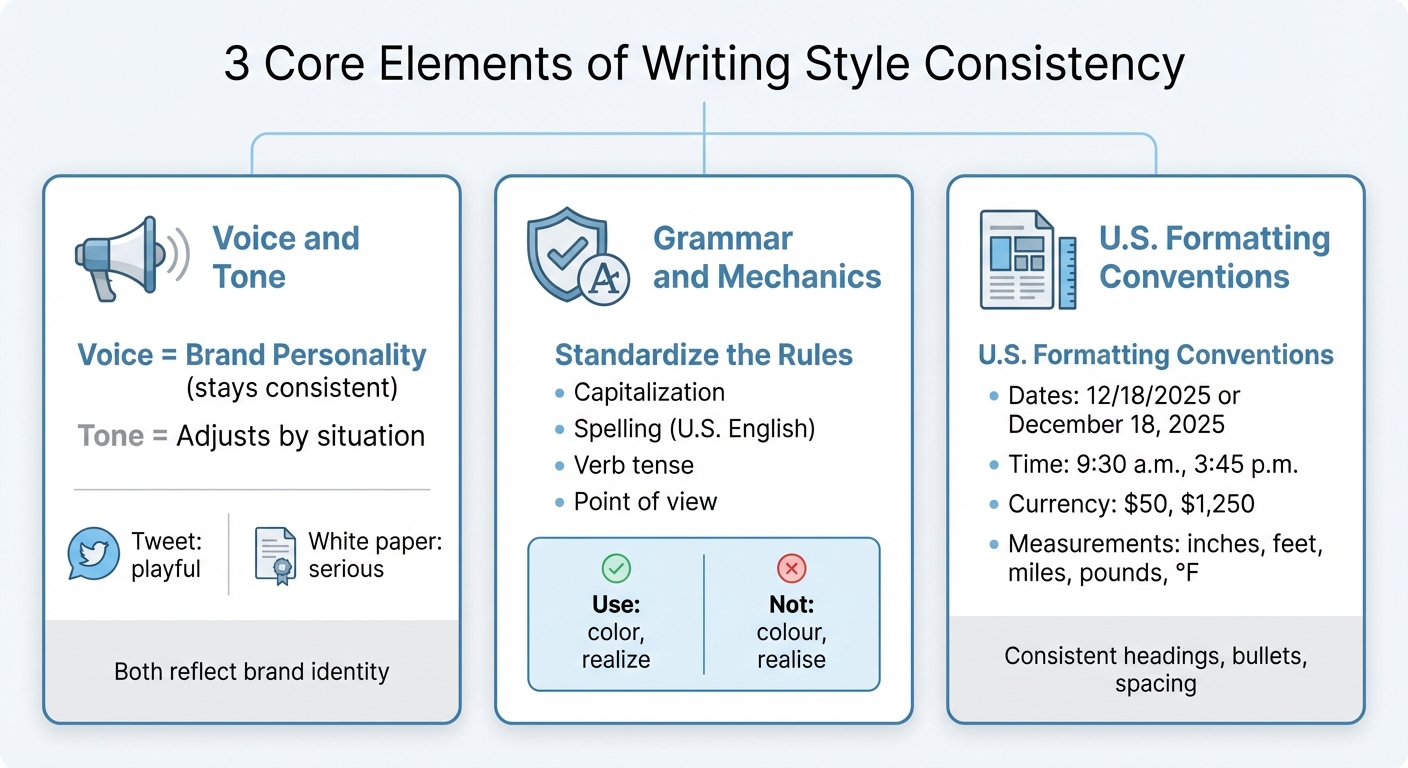
3 Core Elements of Writing Style Consistency
Creating a consistent writing style boils down to three key elements: voice and tone, grammar and mechanics, and formatting standards. When these are mastered, your content will feel cohesive - whether it's an email, a report, or any other type of communication.
Voice and Tone
Your voice is like your brand's personality - it stays the same across all your writing. Tone, on the other hand, adjusts depending on the situation. Atlassian, for instance, describes its brand voice as "Bold, optimistic, and practical with a wink", while Mailchimp has detailed voice and tone guidelines to ensure consistency.
Defining your voice is essential. Is it formal? Casual? Somewhere in between? Once that's clear, apply it consistently. Keep in mind that tone may vary based on the platform or medium. A tweet might be snappy and playful, while a white paper demands a more serious tone. Regardless of the medium, both should reflect your brand's identity.
Grammar and Mechanics
Grammar is the backbone of any writing style. Standardizing rules for capitalization, punctuation, spelling, verb tense, and point of view keeps your content polished and professional. Even if you tweak certain rules to fit your brand's style, make sure those choices are documented so everyone on your team stays aligned.
For U.S. English, stick to American spelling conventions. For example:
- Use "color" instead of "colour."
- Write "realize" instead of "realise".
The Administration for Children and Families (ACF) uses an editorial style guide to ensure all public-facing materials are consistent, authoritative, and reliable. This kind of guide can be a game-changer for maintaining uniformity across your content.
Formatting and U.S. Standards
Formatting ties everything together by ensuring your content looks as polished as it reads. This includes font choices, margins, and how you present dates, times, currency, and measurements. For U.S.-based content, stick to the following conventions:
- Dates: Use the month-day-year format, like 12/18/2025 or December 18, 2025 (with a comma before the year).
- Time: Write times in the 12-hour clock format with "a.m." and "p.m." (e.g., 9:30 a.m. or 3:45 p.m.).
- Currency: Place the dollar sign before the number (e.g., $50, $1,250, or $3.5 million).
- Measurements: Use imperial units, such as inches, feet, miles, pounds, and degrees Fahrenheit.
Beyond these details, establish a consistent structure for documents. This includes headings, bullet points, paragraph spacing, and numbering. A clear and uniform format not only makes your content easier to read but also reduces visual clutter.
How to Create and Use a Style Guide
A style guide acts as the backbone of consistent writing, laying out everything from word choice to punctuation, so your team stays aligned with your brand's voice. Margarita Loktionova of Semrush explains it well: "A content style guide is a document that defines your brand's voice, tone, values, and style for creating content. It specifies how you should speak to your audience whatever the content format". In fact, 45% of a brand's image is shaped by what it says and how it says it.
To get started, focus on the basics and expand as needed. The aim is to create something practical and easy to use - not an overwhelming manual that collects dust. Some style guides stretch to over 200 pages, but that’s not the goal here [4].
What to Include in Your Style Guide
A well-rounded style guide should address four key areas: brand identity, writing mechanics, terminology, and formatting standards. Start by defining your brand's voice and tone - whether you want to come across as formal, conversational, or somewhere in between. This sets the foundation for how your team communicates.
Next, get specific about grammar and punctuation rules. For example, clarify whether you use the Oxford comma, how to handle hyphens and em dashes, and which spelling conventions you follow (e.g., American English uses "color" and "realize", not "colour" and "realise").
Include a terminology section with a list of preferred terms, product names, and words to avoid. Mailchimp’s guide is a great example - it offers a detailed word list to help writers choose language that aligns with the brand.
Formatting standards are another must. Cover details like how to handle dates, times, currency, and measurements. Provide clear guidelines for headings, lists, and paragraph spacing. Examples are crucial - show both what to do and what not to do. Shopify’s style guide, for instance, is divided into 11 sections packed with examples, making it easy for writers to follow.
Updating Your Style Guide
Your style guide isn’t a “set it and forget it” document - it should grow with your brand. Store it in a shared location like Google Docs or OneDrive to ensure everyone accesses the latest version. Assign someone to update it regularly - every six months is a good rule of thumb - and make sure feedback is incorporated promptly.
If new questions pop up - like how to handle a new product name or industry term - update the guide right away. Introduce new team members to the guide during onboarding and remind current staff to refer to it often. Regular use ensures that sticking to the guide becomes second nature.
Once your guide is up to date, you can integrate it into your workflow using tools like Revise.
Setting Up Revise with Your Style Guide
Revise takes the heavy lifting out of enforcing your style guide by applying its rules automatically and in real time. Instead of manually checking every piece of content, Revise learns your preferences - everything from grammar rules to formatting standards - and provides suggestions that reflect your brand voice.
You can train Revise to follow your specific rules, like whether you use the Oxford comma, how headings should be capitalized, or which industry terms to prioritize. It acts as your automated editor, giving your team consistent feedback without requiring them to memorize every detail of the guide. With Revise, every draft aligns with your brand standards from the start.
sbb-itb-df9dc23
Methods for Maintaining Consistency
Once your style guide is ready, keeping your content consistent requires intentional habits, structured workflows, and tools that help catch errors before they reach your audience.
Self-Editing and Review Methods
Reading your draft out loud can uncover awkward phrasing, clunky sentences, or pacing issues that might go unnoticed when reading silently. Hearing the words helps you detect shifts in tone or voice that could disrupt the flow.
Taking a break from your work - whether for a few hours or even a couple of days - can give you fresh eyes. With some distance, inconsistencies or overlooked details often become more apparent.
It’s also helpful to maintain a personal style sheet where you track your specific decisions, like whether you use the Oxford comma, how you format numbers (e.g., "15" versus "fifteen"), or unique capitalization rules. For example, the 2025 AP Stylebook, 57th Edition, offers a detailed self-editing checklist that can guide you in maintaining consistency.
When editing, work in stages. Start by focusing on broader elements like tense, point of view, and terminology. Then, move on to finer details like grammar, punctuation, and adherence to your style guide. Pay special attention to ensuring your tone and voice remain steady throughout. These habits set the foundation for consistency across your work.
Working with Teams
For teams, the style guide becomes a central resource to ensure consistency across all contributors. Share it widely within your organization, so everyone - whether full-time staff, freelancers, or contractors - understands the expectations. This shared understanding reduces confusion, shortens editing timelines, and improves collaboration.
Appoint a lead editor to oversee adherence to the style guide and address any questions. This person can also manage updates and onboard new team members to ensure they’re aligned with the established guidelines. Consistency improves significantly when teams across departments - like marketing, customer support, and product development - follow the same rules.
Including clear examples in your style guide, both of what to do and what to avoid, makes it easier for team members to apply the guidelines correctly. Create a simple process for submitting updates or revisions to the guide so it evolves alongside your team’s needs. As Benjamin Brandall from Process Street emphasizes:
"The number one goal of a style guide is consistency."
Adding Revise to Your Workflow
Building on individual and team efforts, Revise offers automated support for maintaining consistency. It learns your preferences and applies them in real time, with features like change tracking to ensure edits align with your guidelines. Its tone control tool helps you adjust the mood of your writing - whether you’re aiming for formal, casual, or something in between.
Revise also includes an in-document brainstorming tool, allowing you to generate ideas without disrupting your workflow. You can even adjust the level of editing feedback, from light suggestions to detailed line edits. For those who prefer dictation, the Pro and Ultra plans include a speech-to-text feature that transforms your spoken thoughts into polished text. These features streamline your editing process, saving time while keeping your content consistent.
Using AI to Maintain Consistency and Voice
AI tools can speed up your workflow and help catch errors, but they come with a trade-off: the risk of losing your unique voice if not tailored to your needs. Choosing the right tool means finding one that supports and enhances your style instead of replacing it.
Problems with Generic AI Tools
Most off-the-shelf AI tools struggle to capture the subtleties that make your writing distinct. The result? Content that feels flat and generic, missing the personality and tone that truly connect with readers. These tools often fail to reflect your brand identity, leaving you with uninspired output.
Even popular grammar tools fall short when it comes to maintaining consistency. Sure, they might catch basic errors, but they often overlook finer details, like whether you consistently use "e-mail" or "email", or whether "long-term" should be hyphenated. Without proper enforcement of style guidelines, you’re left combing through documents manually, which defeats the purpose of using automation in the first place.
How Revise Provides Personalized Editing
Revise offers a smarter alternative by tailoring its editing capabilities to your specific needs. Unlike generic tools, Revise integrates your preferences to maintain your unique voice.
With Revise, you can set up custom style rules that align with your brand’s tone, terminology, and formatting. Whether you’re aiming for a formal tone in business proposals or a conversational vibe for blog posts, the tone control feature lets you adjust the mood to fit the context.
You also have control over how much the tool edits. Want just a few light tweaks? No problem. Need a deep dive with detailed suggestions? That’s covered too. This flexibility ensures Revise adapts to your project requirements instead of locking you into a rigid editing framework. By uploading examples of your writing, Revise fine-tunes its suggestions to match your personal style.
How Revise Learns Your Preferences
Revise doesn’t just follow a one-size-fits-all approach - it learns from you. Every time you accept or reject a suggestion, the tool refines its understanding of your style. Over time, it gets better at tailoring edits to your specific preferences.
For those using the Pro or Ultra plans, the personalization goes even deeper. These plans include features like document-based chat and access to advanced AI models that excel at understanding context and nuance. With unlimited custom rules and prompts, you can fine-tune Revise to handle even the most specialized writing needs. Whether it’s a quick email or a detailed report, Revise ensures your style remains consistent across all your projects, reinforcing the voice you’ve established in your style guide.
Conclusion
Consistency in writing goes beyond simply sticking to rules - it’s about earning your readers' trust and solidifying your brand identity. When your content consistently reflects the same voice, tone, and style, it becomes easier for readers to engage with and trust your message. This sense of reliability strengthens their confidence in your authority.
A well-crafted style guide serves as the foundation for this consistency, outlining your preferred voice, grammar choices, and formatting rules. But a style guide alone isn’t enough. To make a real impact, you need to weave these guidelines into your daily writing process. Whether you’re working solo or collaborating with a team, disciplined workflows are crucial. They pave the way for tools that can help enforce and maintain your style.
This is where tools like Revise come into play. Revise doesn’t just sit on the sidelines - it actively works with you. By learning your preferences and applying your custom rules, it catches inconsistencies you might overlook. From quick emails to in-depth reports, it ensures that everything you write aligns with your established voice.
Start small. Identify your most common style choices, set up a few custom rules in Revise, and expand from there. By taking deliberate, manageable steps, you’ll gradually refine your process and strengthen both your brand’s voice and your readers’ trust. The goal isn’t to achieve perfection overnight - it’s to build a system that makes staying consistent easier with time.
FAQs
How can I create and maintain a consistent writing style?
To establish a consistent writing style, start by defining your voice - the distinct personality and values that shape your writing. Think about the traits that best represent you or your brand, whether that’s being approachable, professional, or humorous. This voice serves as your foundation and should stay consistent across all types of content, from blog posts to emails to social media updates.
Your tone, on the other hand, can shift depending on the audience or context. For instance, your voice might take on a conversational tone for casual readers, a more formal tone for business communications, or a compassionate tone when addressing customer concerns. Knowing when and how to adjust your tone ensures your message stays clear and resonates with your audience.
To keep things consistent, create a style guide that outlines your voice, tone, and writing rules. Include examples of preferred phrasing, sentence structures, and terminology. Regularly review your content against this guide and update it as needed to match shifts in your audience or brand. Tools like AI writing assistants or simple checklists can also help you stay aligned with your style.
What key elements should a writing style guide include?
A writing style guide plays a crucial role in ensuring that all content reflects a brand's personality while maintaining a consistent and professional tone. It serves as a roadmap for writers, helping them align with the brand’s identity. Here are some key components every style guide should include:
- Voice and tone: Clearly define the brand's voice - whether it’s warm, professional, or conversational - and outline how the tone should adapt based on the audience or type of content.
- Grammar, punctuation, and style: Establish rules for grammar, sentence structure, spelling (such as using American English), punctuation preferences (including whether to use the Oxford comma), and overall writing style.
- Formatting standards: Provide clear instructions for structuring content, including headings, lists, tables, and the use of visual elements, to ensure a consistent look and feel.
- Terminology: Include a glossary of approved terms, product names, and guidelines for acronyms or abbreviations to avoid confusion and maintain accuracy.
- Inclusivity and accessibility: Offer practical tips for using plain language, gender-neutral phrasing, and ensuring readability so that all content feels welcoming and easy to understand.
A well-crafted style guide gives writers the tools they need to produce cohesive, on-brand content across various platforms and formats.
How does Revise help ensure consistent writing style across all content?
Revise offers cutting-edge tools designed to keep your writing style consistent across all your content. It examines your text, spots patterns, and delivers personalized suggestions to match your unique voice or brand identity.
With features like AI-driven recommendations and customizable style guides, Revise makes it easier to stick to your preferred tone, grammar, and formatting. This helps ensure your writing stays polished, professional, and in tune with what your audience expects.